
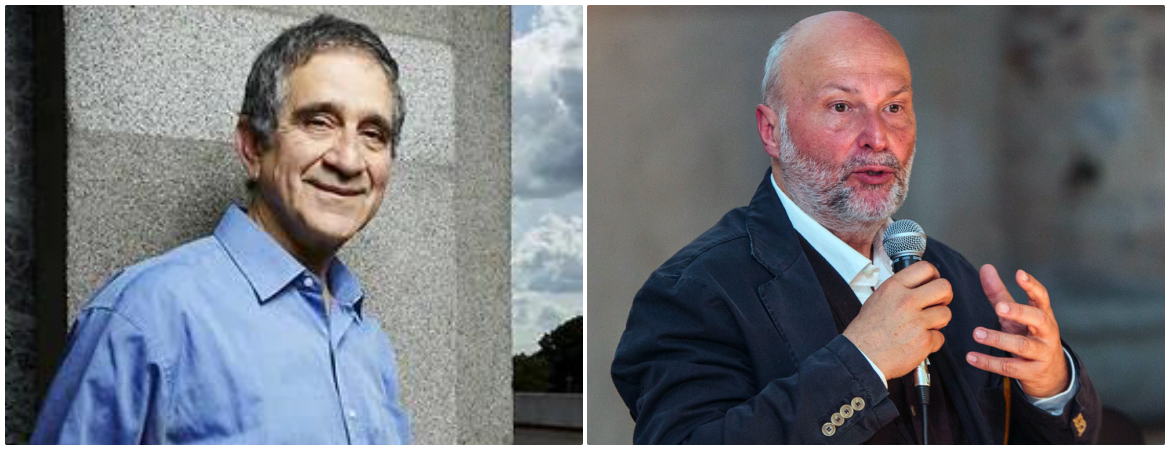
Leading sociologist Farhad Khosrokhavar and philosopher Mauro Ceruti have sent messages of support for the ongoing peace process.
In his message, Khosrokhavar stated:
"Turkey is undergoing a historic process. The Kurdish Question—unresolved throughout the country’s century-long modernization journey—is, for the first time, on the verge of being addressed through democratic and peaceful means. In the Middle East, modernity has still not overcome the tension between the universal and the local, the general and the particular. So how can we differentiate ourselves without losing universality? In other words, how can we reconcile the contradictions between abstract universals and lived singularities? It seems that this is precisely where the region’s persistent fundamentalism and both regional and global imperial interventions become entangled. Kurdish leader Öcalan’s Call for Peace and a Democratic Society offers a dialectical path toward living together without suffering a loss of identity. I fully support Öcalan’s appeal, which promises millions of Kurds a peaceful national liberation that is neither nationalist nor separatist. A Kurdish-Turkish-Arab alliance capable of untangling the Middle Eastern deadlock could render artificial borders obsolete without creating new divisions. In short, we are at a threshold. I hope peace prevails."
Meanwhile, Ceruti said the following in his message:
"I express my full support for the ongoing peace process in Turkey and for the Kurdish political representatives who are striving, with courage and perseverance, to advance dialogue, democracy, and coexistence. Peace is built through responsibility, mutual recognition, and the shared commitment to a future in which diversity becomes a resource for society rather than a source of conflict. I stand in solidarity with all those who are working to make this possible.
In an interconnected world that is regressing toward new nationalisms and new imperialisms, and thereby becoming increasingly fragmented and insecure, in a world where the risk of military conflicts and terrorism is growing, the peace dialogue between the Kurds and the Turkish government opens a concrete path of hope toward a new direction. The right to self-determination of different peoples can be preserved within the framework of a “post-national”, “multinational”, or “cosmopolitical” state, where unity and diversity, national sovereignty and multiculturalism can be reconciled and mutually reinforced, moving beyond the paradigm of ethnic and religious homogeneity and the “sacralization” of territorial borders. This new direction can serve as a positive example in the Middle East and as a precursor to a global community of states genuinely committed to the “common good” of our shared earthly home, at a time when humanity faces the unprecedented possibility of self-destruction."
Farhad Khosrokhavar is a French sociologist of Iranian origin. His work in sociology focuses particularly on radicalization, the sociology of Islam, prisons, and questions of identity in modern societies. He has long served as a researcher and faculty member at prestigious institutions such as the École des Hautes Études en Sciences Sociales (EHESS) and the Maison des Sciences de l’Homme (MSH). His studies on the transformation of Islam in Europe, youth and marginality, jihadism, and prison radicalization have had a broad international impact, producing essential reference works in these fields. Khosrokhavar has authored numerous books in both French and English and has made significant contributions to contemporary debates on security and identity in the social sciences.
Mauro Ceruti began his academic career as a researcher at the University of Geneva, later working in transdisciplinary research centers in Paris and holding faculty positions at various Italian universities, including Milan, Bergamo, and Palermo. He subsequently served as a professor of the philosophy of science at IULM University in Milan, where he later became professor emeritus. Ceruti’s philosophical work spans a wide range of fields, including epistemology, the philosophy of biology, the philosophy of globalization, global ethics, and educational transformation. His research centers on themes such as humanity, globalization, diversity, systems thinking, and the global community. One of Ceruti’s notable contributions is his concept of “planetary thinking,” which emphasizes that humanity shares a single planetary destiny and that ecological, economic, cultural, and political ties are interwoven through mutual interdependence.
1 December 2025