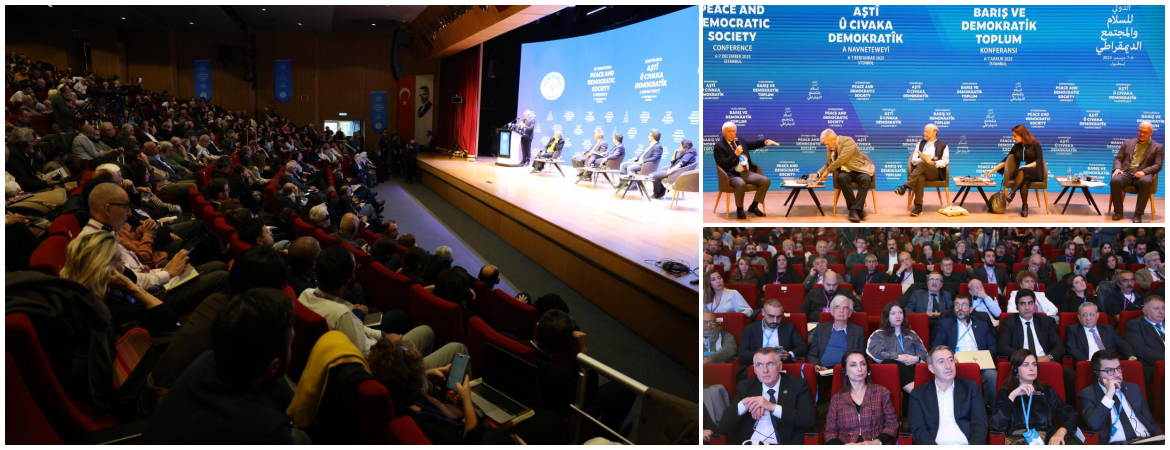
The final declaration of the conference held in Istanbul on 6-7 December 2025:
“International Peace and Democratic Society Conference” held successfully on 6–7 December 2025 in Istanbul. Politicians, academics, journalists, human rights defenders, and parliamentary representatives who have served in various capacities in different countries attended to the conference as speaker or participant from 19 countries across 5 different continents. We, as the international delegation, deeply feel the pain, losses, and destruction caused by the conflict that has continued in Türkiye for over 40 years. We believe that in order to prevent the recurrence of these sufferings, conflicts must fall completely end, and lasting peace must be built through a democratic social contract.
In this period in Türkiye, where the Kurdish people face repression and exclusion with discrimination, we regard the process initiated under the leadership of Mr. Öcalan as an important opportunity for the peoples of Türkiye. However, we also emphasize that it is of vital importance for this process to be carried out in a more inclusive, constructive, and result-oriented manner.
At a time when authoritarian and fascistic tendencies are rising globally, societies need leaderships capable of guiding them toward peace. Mr. Öcalan has demonstrated to the international public—both in practice and intellectually—that he can provide leadership for lasting peace in the face of escalating violence in Türkiye and the Middle East. For this reason, we see Abdullah Öcalan not only as a representative of the Kurdish people but also as an important actor for peace, democratic transformation, and pluralism in Türkiye and the Middle East.
The peace process initiated by Mr. Öcalan on 27 February 2025 constitutes a historic opportunity for the complete cessation of the conflict. The PKK’s decision to end its armed struggle and dissolve itself is a courageous and historic step taken for peace. This step represents a major opportunity for ending the long-standing conflict and instability in the region.
The successful conclusion of this process toward lasting peace in Türkiye—amid rising conflicts across the world—has the potential to guide not only Kurds and the peoples of Türkiye but also the Middle East and the World. The conclusions that emerged from the discussions held during the two-day conference are as follows:
1. As stated in the judgment of the European Court of Human Rights, we regard legal arrangements that recognize the Right to Hope and make Öcalan’s release possible as a requirement of an honorable peace. Until the Right to Hope is fulfilled, we believe that access to Öcalan’s intellectual work by academics, intellectuals, journalists, and politicians, as well as opportunities for direct contact with him, must be ensured. İmralı Island should cease to be a symbol of isolation and should instead become a gateway to peace and a free future for Türkiye. Ultimately, all conditions of isolation imposed in İmralı must be completely lifted.
2. We believe that conflicts need political solutions and dialogue and negotiation are the best way to achieve lasting peace. We highlight that, in accordance with UN Security Council Resolution 1325, women must take a more active role in peace negotiations and in conflict and political resolution processes.
3. We acknowledge Abdullah Öcalan’s view that the nation-state model deepens social inequality, gender domination and environmental harm, and we underline the importance of advancing governance models that ensure women’s equal participation, strengthen local democracy and support peaceful coexistence among diverse communities.
4. We underline the urgent need for legal transformation as part of conflict resolution efforts worldwide. In this context, Türkiye needs a new and democratic social contract that includes all peoples, beliefs, and identities on the basis of equal citizenship. A social contract constructed without excluding any segment of society will fully eliminate the grounds for violence in Türkiye.
5. As demonstrated by experiences in South Africa, Ireland, the Basque Country, and Catalonia throughout the conference, steps must be taken to replace rigid and centralized understandings that lead to conflict with approaches that integrate society and eliminate violence. In Türkiye, methods of local governance should be discussed at both the political and societal levels. Within these discussions, laws that strengthen local administrations in Türkiye should be enacted.
6. We note the positive approach of the European Parliament, yet we believe that the European Union as a whole must assume a more active and constructive role. When necessary—and if accepted by the parties—we remind that the EU could contribute to the peace process as a mediator or guarantor.
With regard to the future of peace and democratic transformation in Türkiye, ensuring the freedom of all political prisoners—first and foremost Abdullah Öcalan and all politicians in Kobanî Case—within the framework required by the law of peace is not a matter of grace or choice, but rather a historical and legal necessity. The severe isolation imposed for more than twenty-six years is clearly incompatible with both national and international law. We call on Türkiye to act in accordance with its obligations under human rights and humanitarian law.
We regard this declaration as a historic step taken on the path to lasting peace and call on all parties to fulfil their responsibilities. We are determined to follow the progress of the process and to maintain our hope for a transition to a democratic and inclusive society.
International Participants of the “International Conference on Peace and Democratic Society”
11 December 2025
Translations of the declaration in other languages: