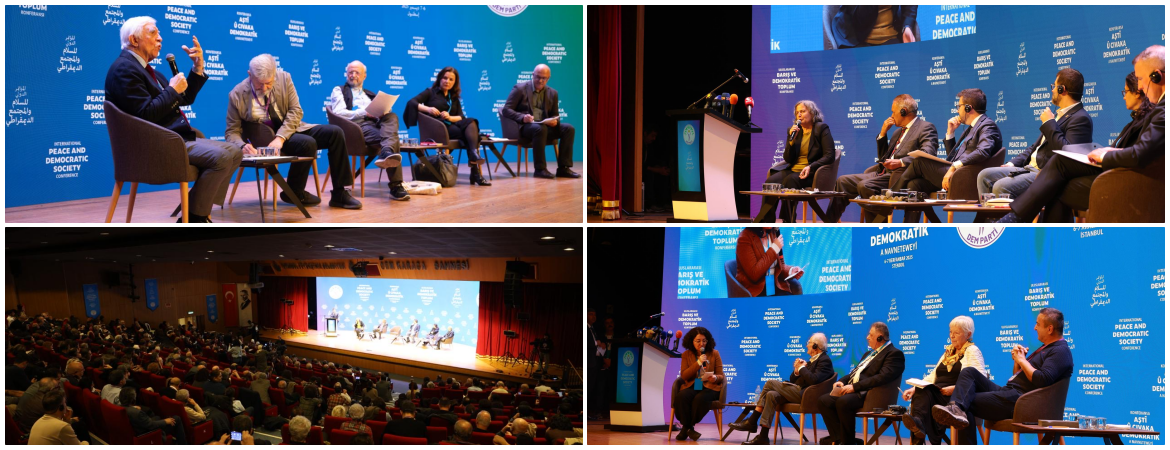
The International Peace and Democratic Society Conference convened in Istanbul on 6-7 December, bringing together politicians, former heads of government, parliament members, Nobel Peace Prize laureates, academics, and human rights defenders from across the world.
The two-day conference opened with keynote speeches from our Co-Chairs Tülay Hatimoğulları and Tuncer Bakırhan. Following their remarks, Mr. Öcalan's message was read out by Veysi Aktaş.
Afterwards, İlham Ahmed, Foreign Affairs Committee Chair of the AANES, delivered a speech in which she briefly said:
“Peace within Syria means peace within Turkey. When there is a democratic republic, a democratic system, and a democratic constitution in Syria—where the rights of all communities are guaranteed—this will have a positive effect on Turkey, and peace will also be created within Turkey.
“Without Kurds and other communities gaining their rights, it is not possible to build a new and democratic Syria. Therefore, I consider the ongoing dialogue on peace extremely important. Others, too, must engage in these discussions and dialogues with conviction, with confidence, and with determination.”
Throughout the two-day program, participants from different countries and communities shared their experiences in social peace, conflict resolution, democratic approaches, and the collective future.
The guest speakers delivered their remarks during the sessions titled “Perspectives for Social Peace” and “Experiences in Conflict Resolution”. Highlights from the speeches were as follows:
Prof. Louis Lemkow, Autonomous University of Barcelona:
“Dialogue and debate are indispensable for peace. We are working to make peace a part of the school curriculum. This is crucial for embedding peace within society.”
Assoc. Prof. Arzu Yılmaz, University of Kurdistan Hewlêr:
“It is about integrating Kurds into the law and bringing them within the norm. With his proposals, Öcalan offers significant input on how this could take shape.”
Prof. Dr. Cihangir İslam:
“We were compelled to build a nation-state. But what has this produced? Without honestly examining this, we cannot move forward. At a time when talk of a Third World War is in the air, important steps can be taken to present peace between Turks and Kurds as an example to the world.
“As Öcalan has emphasized, a serious reckoning is needed regarding what the nation-state has given or failed to give us. We must act with an understanding that expands gains.”
Özgür Erol, Member of the İmralı Delegation:
“Kurdishness has been kept outside the law. Since 1925, the word ‘Kurd’ has been automatically associated with rebellion. This narrative coded Kurdish identity as a threat. Because Kurdishness has been kept in illegality, unlawful behavior has been normalized in this country. Unless the issue of Kurds’ legal status is resolved, you cannot speak of Kurdish rights, or you leave a huge vacuum.
“The right of hope is entirely tied to this. They want to benefit from Mr. Öcalan’s influence, yet insist he remain where he is. This is unacceptable. They want to perpetuate the criminalization of Kurdishness through Mr. Öcalan. Within the ECHR framework, many steps can be taken in this transitional stage. Conditions for living and working freely must be ensured. This would be a significant development.”
Dilshad Shahab, Spokesperson for the Kurdistan Regional Government Presidency, read a message from President Nechirvan Barzani:
“We have seen that violence and hostility bring no positive outcome for the peoples of the region. There is a determination for peace and stability now. And this will affect the entire Kurdistan Region. Dialogue will bring major gains. As the Kurdistan Region, we will play our role in establishing peace and stability. We congratulate President Öcalan for his commitment to building peace and coexistence.”
Mohamed Bhabha, Chair of the Parliamentary Constitutional Committee, South Africa:
“After the apartheid regime, we needed to construct a concept of the state. That required a primary national identity, namely, being ‘South African.’ Secondly, we never ignored the separation of powers. We needed a state where power is not abused.
“Resolution processes must be transparent if you want them to be sustainable, no matter the circumstances. In negotiations, things may sometimes look bleak, but history presents unexpected opportunities, and we must remain open to them.”
Declan Kearney, National Chairperson of Sinn Féin, sharing the Irish peace process experience, said:
“None of this happened at once. It was a process carried forward through ongoing negotiations. Sinn Féin views negotiation as the struggle for lasting peace. Both sides must participate in good faith, and trust is essential. Civil society and grassroots involvement must be activated.
“We stand in solidarity with the Kurdish representatives seeking fresh hope with the Turkish government. The Turkish government must embrace the opportunity offered by the Kurdish people. I believe in the right to hope. I call for peace and democracy for the Kurdish people, and freedom for Abdullah Öcalan.”
Former Catalonia Prime Minister Pere Aragonès:
“We learned several lessons from our negotiation process. First, we need a long-term vision. A conflict rooted in history cannot be solved in a day. It takes time. Second, our process was not linear. Third, narrative is crucial. No one wants to appear as the loser in a negotiation. If your narrative aims to belittle the other side, you lose the negotiation. We developed methods to avoid this. Fourth, you will face many spoilers. Avoiding such behavior is essential. The most important negotiation is the one you conduct with your own people. Finally, leadership and inclusivity matter greatly. Leadership is crucial. Your leader (Öcalan) transformed his people’s suffering into a path toward peace.”
Igor Zulaika, Member of the Basque Parliament and EH Bildu International Relations Coordinator:
Speaking about the conflict and negotiation processes between the Basque Country and the Spanish government, Zulaika emphasized the importance of leadership. “Öcalan’s participation in this process is essential, and he must be released. The Turkish government must take the necessary legal steps.”
Former political prisoner and politician Azime Işık:
“In a society where there is social peace, there is no need for prisons. If we are to speak of social peace in the coming period, we must also speak of justice as a legal standard. All political prisoners must be released, and freedom laws must be enacted for social peace.”
Nobel Peace Prize laureate Jody Williams, attending via teleconference said:
“The Turkish government is reluctant to create real change. This is troubling. Öcalan’s call is a call for peace and brotherhood. He has worked for peace. Despite the harsh conditions, he has maintained his commitment to peace even in prison. As Nobel laureates, we recognize and support this initiative. We call for his release. Öcalan must be freed to send the message to the region that change is possible.”
On the second day, the guest speakers delivered their remarks during the sessions titled “From Nation-State to Democratic Nation” and “Freedom, Peace, and Future Perspectives”. Highlights from the speeches were as follows:
Dr. Orhan Gazi Ertekin:
“The Turkish Constitution has always functioned through a dual legal order. One is the constitution itself, and the other is the Anti-Terror Law, which has created its own notion of constitutionalism. This dual legal system has continuously divided society. As a result, it has constantly rebuilt itself through discrimination and ethnic and religious hierarchies.”
Egyptian professor of contemporary history, former dean, and scholar at Damanhour University, Prof. Mohamed Refaat emphasized the significance of Öcalan in the Kurdish struggle during his presentation titled “The Importance of Historical Experiences in Building a Democratic Nation”. He noted that he teaches university courses on the Kurdish people’s struggle.
Academic, lawyer, and politician Prof. Norman Paech from Germany, in his presentation “Strengthening Local Democracy Against Centralization and Resistance to Hegemonic Relations” recalled visiting Öcalan in 1996 and engaging in important discussions. Paech said they debated autonomy and self-governance and added, “Öcalan’s concept of a ‘democratic nation’ is one that unites diverse identities under shared democratic norms and surpasses the traditional state model.”
He stressed that democracy is the only path to overcoming war: “For a people such as the Kurds, the right to self-determination is essential for the recognition of their identity.” Paech added, “By aiming for decentralization, Öcalan put forward the claim of democratizing Turkey.”
Journalist and writer Nadire Mater said, “Today, we’ve moved from media owned by corporate conglomerates to media controlled by the AKP. We must distinguish between pro-government and anti-government media. Truly independent media is very scarce. Journalists are hopeless and often no longer even motivated to report. Because of censorship, the struggle to report news has become extremely difficult. During the peace process, this fragile environment suffered from serious negligence. Aggressive language only harms it further. Each of us has significant responsibilities in this regard.”
Narin Nadirova, a member of the Kazakhstan People’s Assembly, delivered a speech in Kurdish titled “Soviet-Era Kurds and the Meaninglessness of Borders”. She stated that her ancestors were exiled from the Serhat region following the Sheikh Said rebellion. “We have great hopes that the peace and democracy process will open new doors. I wish success to everyone,” she said.
Marxist lawyer, sociologist, and philosopher Holloway: A Light That Shines in the Darkness
“I traveled (from Mexico) 11,000 kilometers to be here with you. Why did I come? Because I was drawn by a light that shines in the darkness.”He continued:
“It was the light of Öcalan and the Kurdish Freedom Movement, a light shining amid the world’s darkness and against that darkness. This world is a cruel and dark place, and that is why seeing lights that shine in the darkness is so important to me. To see lights that move against the flow of capital. For me, there are two such lights in the sky: the Kurdish Freedom Movement and the Zapatista Movement in Mexico. We are all trying to create light in the darkness.
“Both the Kurdish movement and the Zapatistas have developed communal practices to a remarkable level. A second shared characteristic is their anti-statism. Every state, in its broadest form, relies on racism and discrimination among its citizens. The state as an organizational form leads to war; the commune leads to peace. Öcalan was right when he said that the oldest form of slavery is the enslavement of women. Fourth, these lights oppose ecological destruction; we must build a harmonious relationship with nature. Fifth, they reject nationalism. The Zapatistas abandoned national liberation struggles long ago. Öcalan, in his Sociology of Freedom, makes this rejection beautifully and calls for abandoning identity-based politics.
“In your difficult, detailed, and important negotiations with the Turkish state -negotiations I support-I hope you do not lose your radicalism or forget how special you are. Remember that the peoples of the world look to you and seek hope in you. That is why I crossed oceans and continents to come to Istanbul: to express my full support for you, for Öcalan, and for the Kurdish Freedom Movement in the peace process.”
Laura Boldrini, Chair of the Human Rights Committee of the Italian Parliament:
"The process initiated by Öcalan on February 27 and the PKK’s dissolution presented an important opportunity for regional stability. I cannot say that the international community has seized this opportunity. I would have liked to see messages appreciating Öcalan’s statement and the PKK’s decision to lay down arms. The EU can engage at every level and act as a guarantor. Öcalan’s call for disarmament is also a call for democratization. Europe must show the determination and courage needed for Öcalan’s release and must voice this clearly. The release of Öcalan and all political prisoners is indispensable. Demirtaş’s release is an obligation under ECHR rulings. EU countries must break this shameful silence, support the process, and stand by the Kurdish people.”
Haydar Ergül, editor of Democratic Modernity magazine:
“Twenty-seven years ago, I spent nearly 50 days with Öcalan in Rome during a hard and challenging period. In those dark days, we would ask ourselves what would happen. I always followed a small light, and by nurturing that light, we came to where we are today. But today, as I listened to Comrade Holloway, I realized that this light is Öcalan himself. The essence of his manifesto is clear: it is the light. It affected not only us but the entire world.
“The essence of Öcalan’s manifesto is a return to essence, to a society centered on women.
“Many were surprised by Öcalan’s February 27 call. Replacing the state with the commune is central to Öcalan’s critique of Marxism. Socialism, at its core, is the commune, communality.”
On the other hand, Giacomo Filibeck, Secretary General of the Party of European Socialists; Simon Dubbins, UNITE’s Director of International Relations; and Brando Benifei, Member of the European Parliament from the Socialist Group sent video messages.
Additionally, the written messages from former HDP Co-Chairs Figen Yüksekdağ and Selahattin Demirtaş, who extended their greetings and wished success to the participants were read.
Following a video message by Nobel Peace Prize laureate and lawyer Shirin Ebadi, several guests spoke at the forum.
The conference’s final declaration -in English, Turkish, and Kurdish (Kurmanji)- will be announced in the coming days.
7 December 2025