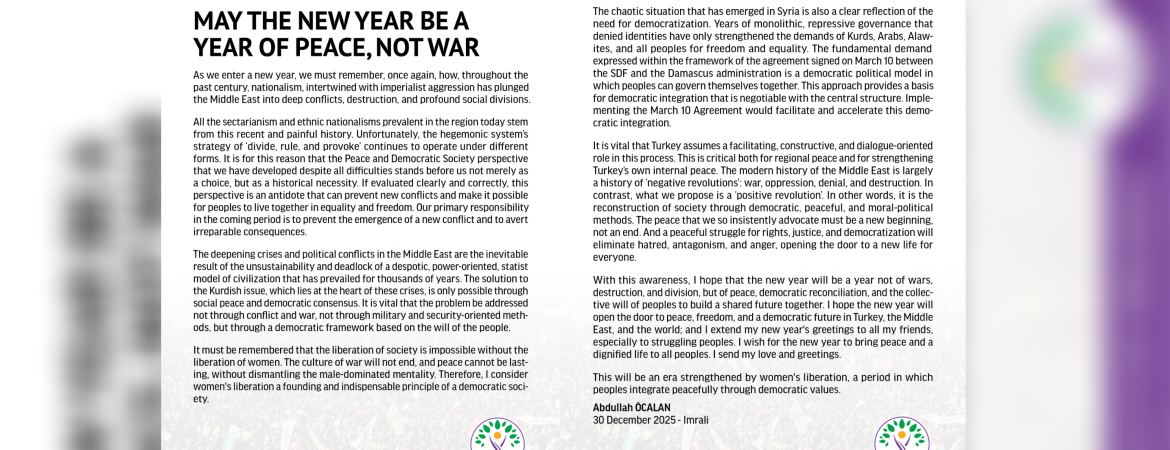
English, Kurdish (Kurmanji) and Arabic versions of Mr. Abdullah Öcalan’s New Year message:
As we enter a new year, we must remember, once again, how, throughout the past century, nationalism, intertwined with imperialist aggression has plunged the Middle East into deep conflicts, destruction, and profound social divisions.
All the sectarianism and ethnic nationalisms prevalent in the region today stem from this recent and painful history. Unfortunately, the hegemonic system’s strategy of ‘divide, rule, and provoke’ continues to operate under different forms.
It is for this reason that the Peace and Democratic Society perspective that we have developed despite all difficulties stands before us not merely as a choice, but as a historical necessity. If evaluated clearly and correctly, this perspective is an antidote that can prevent new conflicts and make it possible for peoples to live together in equality and freedom. Our primary responsibility in the coming period is to prevent the emergence of a new conflict and to avert irreparable consequences.
The deepening crises and political conflicts in the Middle East are the inevitable result of the unsustainability and deadlock of a despotic, power-oriented, statist model of civilization that has prevailed for thousands of years.
The solution to the Kurdish issue, which lies at the heart of these crises, is only possible through social peace and democratic consensus. It is vital that the problem be addressed not through conflict and war, not through military and security-oriented methods, but through a democratic framework based on the will of the people.
It must be remembered that the liberation of society is impossible without the liberation of women. The culture of war will not end, and peace cannot be lasting, without dismantling the male-dominated mentality. Therefore, I consider women's liberation a founding and indispensable principle of a democratic society.
The chaotic situation that has emerged in Syria is also a clear reflection of the need for democratization. Years of monolithic, repressive governance that denied identities have only strengthened the demands of Kurds, Arabs, Alawites, and all peoples for freedom and equality. The fundamental demand expressed within the framework of the agreement signed on March 10 between the SDF and the Damascus administration is a democratic political model in which peoples can govern themselves together. This approach provides a basis for democratic integration that is negotiable with the central structure. Implementing the March 10 Agreement would facilitate and accelerate this democratic integration.
It is vital that Turkey assumes a facilitating, constructive, and dialogue-oriented role in this process. This is critical both for regional peace and for strengthening Turkey’s own internal peace.
The modern history of the Middle East is largely a history of ‘negative revolutions’: war, oppression, denial, and destruction. In contrast, what we propose is a ‘positive revolution’. In other words, it is the reconstruction of society through democratic, peaceful, and moral-political methods. The peace that we so insistently advocate must be a new beginning, not an end. And a peaceful struggle for rights, justice, and democratization will eliminate hatred, antagonism, and anger, opening the door to a new life for everyone.
With this awareness, I hope that the new year will be a year not of wars, destruction, and division, but of peace, democratic reconciliation, and the collective will of peoples to build a shared future together.
I hope the new year will open the door to peace, freedom, and a democratic future in Turkey, the Middle East, and the world; and I extend my new year's greetings to all my friends, especially to struggling peoples.
I wish for the new year to bring peace and a dignified life to all peoples. I send my love and greetings.
This will be an era strengthened by women's liberation, a period in which peoples integrate peacefully through democratic values.
Abdullah ÖCALAN
İmralı Island
30 December 2025
Kurdish (Kurmanji) version of the message
Turkish version of the message